

If a business in Germany or France needed to find a supplier for an industrial solution like yours tomorrow, how likely would it be to find you? And if it did, would it find enough information to shortlist your company and request a quotation?
I’d suggest an exercise that every manufacturer or industrial solutions provider should carry out from time to time: research your own company as a prospective buyer would.
You may uncover opportunities for improvement that you hadn’t previously considered.

Much of the buying process happens out of sight of your sales team
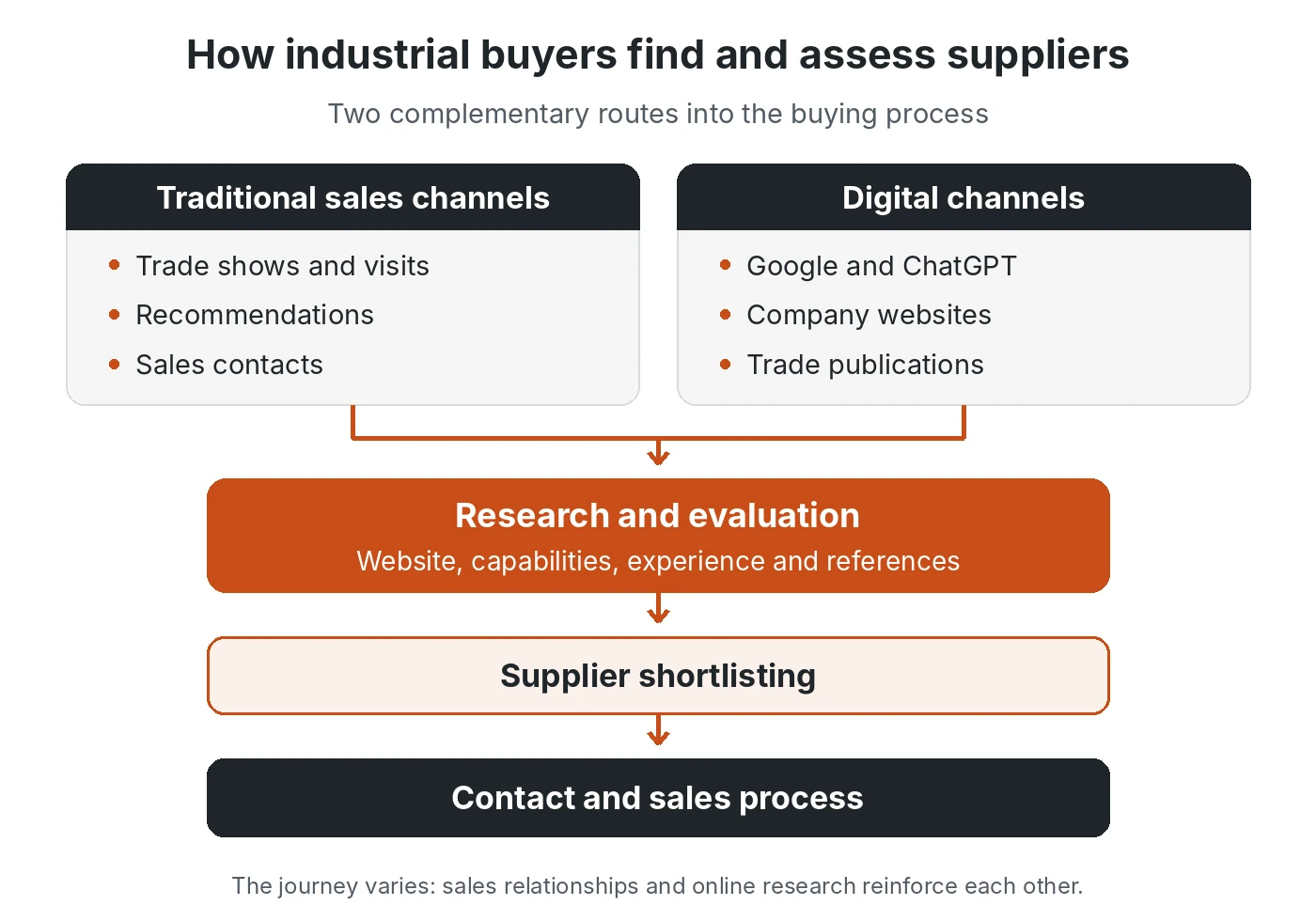
In industry, personal relationships, recommendations, trade shows and sales visits remain essential. For many businesses, it’s difficult to imagine a sale without the involvement of both technical and sales teams.
But what happens between those interactions?
A buyer might meet your company at a trade show, visit your website a few days later, look at projects you’ve completed, check references and compare your capabilities with those of other suppliers.
They might also use Google or tools such as ChatGPT to find manufacturers they haven’t come across before or research alternatives to their existing suppliers.
Much of that activity may take place without you being aware of it.
That’s why, when working to improve an industrial company’s online presence, I’m as interested in making better use of the opportunities its sales team is already generating as I am in helping it reach new prospects.
Would a buyer who has never heard of your company find you?
Think of one of the products or services you most want to sell.
Now put yourself in the position of a procurement manager or engineer at a company that needs that solution but has never heard of your business.
What would you search for?
If you manufacture heat exchangers for industrial applications, for example, a buyer might look for heat exchanger manufacturers, suppliers specialising in a particular industry or solutions suited to specific operating conditions.
They might know exactly what equipment they need. Equally, they might have a technical problem and be exploring different ways to solve it.
Either situation presents an opportunity for them to discover your company.
I’d recommend trying several of those searches in Google and ChatGPT, paying attention to three things:
- Which companies appear.
- What information is presented about them.
- Whether your company appears and how it is described.
If you operate internationally, repeat the exercise for one of your priority export markets, using the language and technical terminology your buyers use there.
Bear in mind that a single search cannot tell you everything about your visibility. Results can vary according to location, the query and other factors. Nevertheless, the exercise can help identify areas worth investigating.
What if the buyer already knows your company?
I find this second exercise equally worthwhile.
Imagine that one of your sales team has just had a promising meeting with a prospective customer. Your solution appears to meet their requirements, and the buyer wants to do a little more research before taking things further.
As well as visiting your website, they might ask ChatGPT something along these lines:
We’re considering [company name] as a potential supplier of [solution] for a project in [country]. What can you tell me about its capabilities, experience and areas of specialisation? Which other suppliers should we consider?
They may receive information about your company and some potential alternatives, although the answer will depend on the information available and may contain errors.
Try it yourself and check the information against the original sources.
Does it accurately describe what you do? Does it identify your main capabilities? Can it find projects you’ve actually delivered? Are there important aspects of your offering that it overlooks?
Until a few years ago, much of this research was carried out through Google and company websites. There’s now another avenue that deserves our attention.
Can your website answer a buyer’s questions?
When we work with industrial businesses, we often encounter websites that devote considerable space to their facilities, company history, products and technical specifications.
All of that matters. But I believe we can make much better use of the information by organising it around the people who need to buy.
Within a single buying organisation, different teams may have very different requirements.
Imagine a project involving galvanised structural steelwork.
| Buying role | What they may need to know |
|---|---|
| Engineering | Applicable standards, technical requirements and limitations. |
| Procurement | Production capacity, lead times and supply arrangements. |
| Maintenance | Durability, corrosion protection and in-service performance. |
They’re all interested in the same solution, but they’re assessing it from different perspectives.
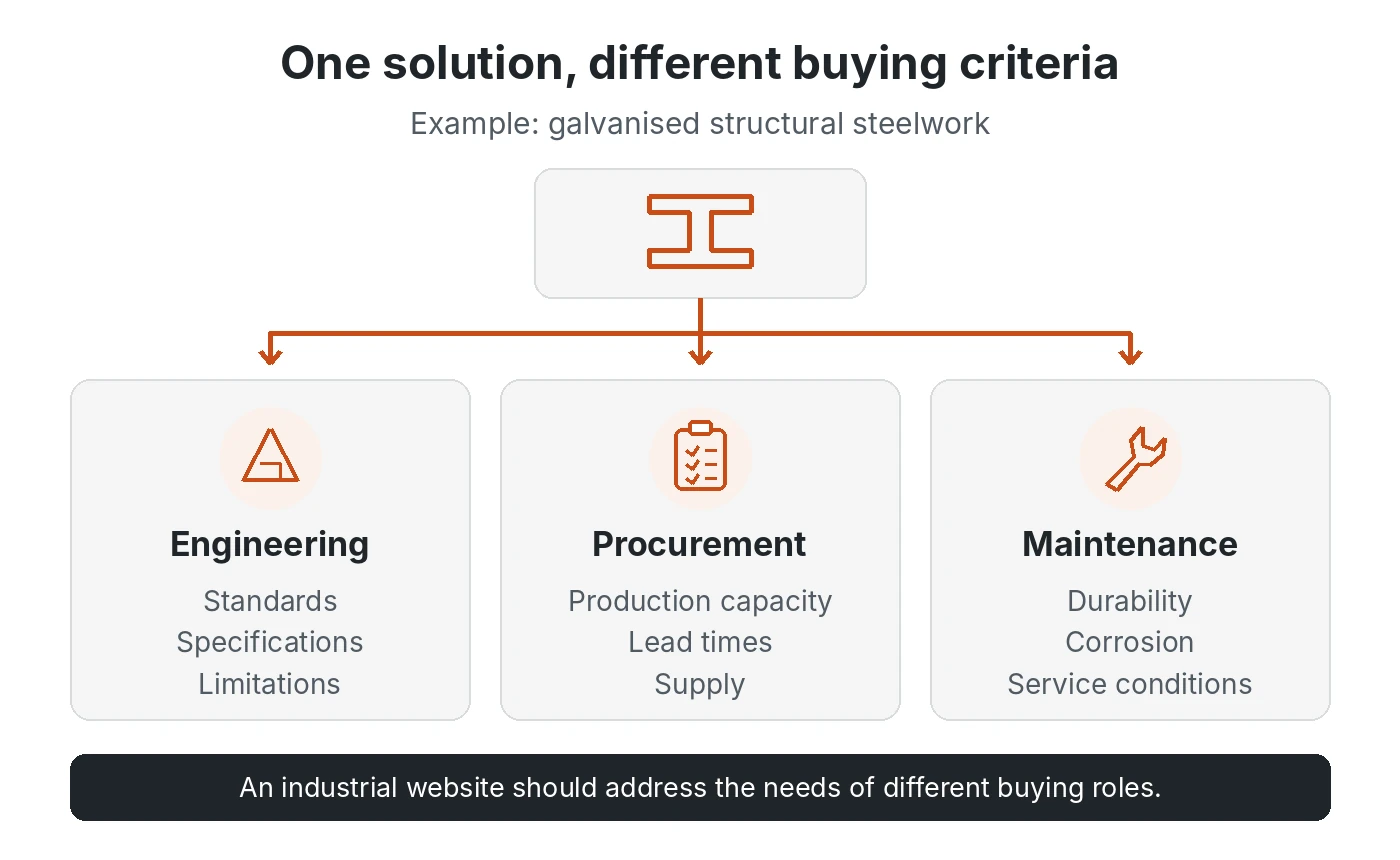
Would each of them find enough information on your website to assess what you offer?
Your own departments are an excellent source of ideas. Ask your sales and technical teams which questions they frequently receive, what concerns customers raise and what they repeatedly have to explain.
Some of that work could already be done by the time a buyer gets in touch.
Make better use of the knowledge already within your business
One of the biggest opportunities I see in industry is the wealth of expertise and experience that businesses possess but rarely communicate online.
Think about everything you’ve learnt from delivering projects, troubleshooting problems, adapting products to specific applications and working with customers across different industries.
How much of that knowledge is available to a prospective buyer?
If you say your company can handle complex projects, it’s far more persuasive to show an actual project and explain what made it challenging, how you approached it and what solution you developed.
The same applies to certifications, testing, quality control and customer references.
I’m aware that much industrial information cannot be shared for confidentiality reasons. Even so, there is usually scope to communicate more than we currently do.
That technical expertise can also become articles, sales support materials, contributions to trade publications or content developed jointly with customers and partners.
And it has one particular advantage: your experience is difficult for a competitor to replicate.
What other organisations say about your business matters too
If you’re looking for a supplier for an important project, you’re likely to value references you can find independently of its own website.
A case study published by a customer, a joint project with another industrial business, an interview in a trade publication or a technical article on a trade association’s website can all provide useful information and lend credibility.
Many industrial companies have longstanding professional relationships that could also be put to good use in this way.
Perhaps you’ve delivered an interesting project with a customer and could document it together. Or your technical team might have expertise worth sharing with a specialist publication.
As well as helping buyers get to know your business, these publications may contribute to your visibility in search engines and AI tools.
How to make your online presence support your sales team
Imagine your export team wants to grow sales of a particular product range in France.
You could work on your online presence so that:
- French buyers can find your solution when they search for it.
- The information addresses their needs and uses the terminology they’re familiar with.
- They can find projects and references relevant to their industry.
- Your sales team has useful content to help prepare for meetings, respond to enquiries and follow up with prospective customers.
In this context, SEO serves a very specific commercial purpose.
That’s why I believe marketing priorities should be closely aligned with those of sales and senior management.
If a market, product range or industry is particularly important to the business, it’s worth considering how your online presence can contribute to that objective.
And if you operate across several countries, remember that translating a website and adapting its content to the needs of individual markets are two different jobs.
Where I’d start
Trying to improve your entire digital presence at once can be difficult, particularly when resources are limited.
I’d start by choosing a strategically important product or service and a priority market. Then I’d assess the situation by answering six questions:
- Can buyers find us when they search for a solution like ours?
- What information do they find about our company in Google and ChatGPT?
- Do we explain our solutions in terms of the buyer’s actual needs?
- Do we provide sufficient evidence of our experience and capabilities?
- What references can buyers find outside our own website?
- Does our sales team make use of the content we’ve published?
The answers will help you identify where to concentrate your efforts.
In some cases, the priority will be improving the structure and performance of the website. In others, it will be developing specialist content, improving visibility in a particular market or building more external references.
These are areas we address through industrial SEO, and they can also help improve a company’s visibility in AI tools.
The important thing is to prioritise according to the needs of the business.
Be found, understood and considered as a supplier
When I work with an industrial business, I’m particularly interested in what its online presence can contribute to the business itself.
More website visits and better Google rankings are useful indicators, but we should go further and ask who’s finding us, what information they’re getting and whether we’re making it easier for the people responsible for generating and closing sales opportunities.
Many factors influence an industrial sale, including technical capability, price, lead times, commercial relationships and how well the solution meets the customer’s requirements.
Your online presence can help your company enter that conversation better prepared.
I’d encourage you to work through the six questions above with your sales and technical teams. Their answers are a useful starting point for deciding what needs to improve.