
Some industrial businesses, whether they export or not, can explain very clearly why their customers buy from them. The problem is that many of those arguments never appear on their websites.
Their salespeople understand buyers’ concerns, know which questions need answering and which of the company’s strengths matter when securing an order.
Yet when a potential customer visits the website, they find products, technical datasheets and corporate information. All perfectly valid, but not always enough to understand why they should consider that manufacturer rather than another.
When a business wants to sell in a country where it does not yet have an established reputation, it faces an additional challenge: the buyer has fewer references to draw on and needs to establish whether it will be a reliable supplier, even from hundreds or thousands of miles away.
An industrial website builds trust when it helps buyers verify that the manufacturer understands their needs, can meet them and can demonstrate that capability.
It is not enough to attract more visitors. Those who already arrive also need reasons to keep considering the business as a potential supplier.

Contents
- Buyers start evaluating suppliers before speaking to sales
- When the sales team understands buyers better than the website does
- What do buyers need to find to trust a manufacturer?
- Does the manufacturer understand what I need?
- Can they demonstrate that they are a reliable supplier?
- What happens after I place an order?
- Do I have the arguments to justify this choice?
- How can you reflect buyers’ concerns in website content?
- Before investing in more traffic, review what existing visitors find
Buyers start evaluating suppliers before speaking to sales
According to the 6sense B2B Buyer Experience Report 2025, based on nearly 4,000 B2B buyers, first contact with suppliers happened, on average, when buyers were already 61% of the way through their buying process.
The study also reports that, in 95% of cases, the supplier ultimately chosen was already on the initial shortlist.
The research covers different B2B categories, so we cannot apply its percentages directly to every industrial sector. But it does highlight the importance of being considered early in the buying process.
During that time, buyers may visit websites, review technical documentation, compare manufacturers, ask for recommendations or use Google and AI tools to research alternatives.
An existing reputation and business relationships also play a part. But the information buyers find online can help them assess a manufacturer they do not yet know.
There is another interesting finding.
The dentsu B2B Superpowers Index 2025, based on 6,107 interviews with B2B decision-makers, identifies the same leading factor in supplier selection for the third consecutive year: feeling confident about signing a contract with them.
Trust depends on many factors: the product, experience, references, the business relationship and service.
The website does not replace any of these. But it can help communicate them well before a sales conversation takes place.
When the sales team understands buyers better than the website does
On a project with a manufacturer of finished homeware products, we asked to work closely with its sales team from the outset. In my experience, that is not always standard practice in industrial SEO projects.
During the first conversations, we discovered something interesting.
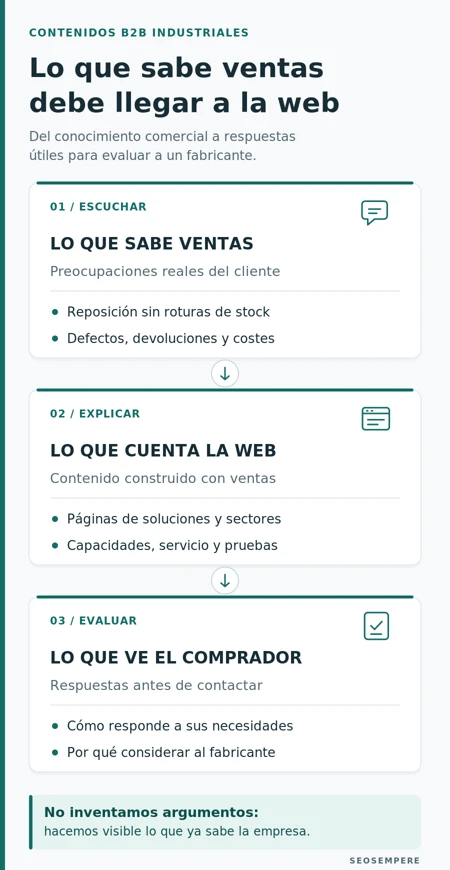
The salespeople understood their buyers’ needs, concerns and the arguments that helped them decide very well.
For example, some buyers particularly valued being able to replenish a product quickly when it was selling well, to avoid stockouts and lost sales opportunities.
They were also concerned about minimising defective batches because of the problems, returns and costs these could cause.
Yet there was barely a trace of these concerns on the website.
It mainly functioned as a technical catalogue: it displayed products and their features, but made little use of the sales team’s knowledge of buyers.
When we rethought the website architecture and content, those needs, alongside others identified with the sales team, helped us decide which information belonged on solution and sector pages and how to explain it.
We wanted website visitors to find the products they were looking for, of course, but also to recognise their own concerns and understand that the manufacturer knew what their business needed.
The most interesting part was that all this information already existed within the company.
We did not have to invent new sales arguments. We needed to speak to the people who understood buyers best and bring that knowledge onto the website.
Another equally important issue, if not more so, is that knowledge of buyers’ needs often belongs to an individual rather than the team. When that salesperson leaves, it is lost. Be mindful of that.
This approach is particularly useful on international projects too. Buyers’ needs and concerns can, however, vary between markets. It is worth checking which sales arguments work in each country rather than simply translating the original website’s content.
What do buyers need to find to trust a manufacturer?
Not all industrial buyers look for the same things. Their priorities depend on the product, application, market and risks associated with the purchase.
That is why a good industrial website should go beyond listing capabilities. It should connect them to potential customers’ needs.
| The buyer’s concern | What they should find on the website |
|---|---|
| Is the product suitable for my application? | Applications, relevant specifications and operating conditions. |
| Can I replenish stock quickly if demand increases? | Supply capacity, lead times and actual replenishment terms. |
| How can I reduce quality issues? | Quality controls, applicable certifications and verifiable procedures. |
| Do they have experience with similar requirements? | Completed projects, sectors served and documented case studies. |
| What support will I receive after buying? | Technical assistance, geographical coverage and service terms. |
Several questions are worth reviewing.
Does the manufacturer understand what I need?
A technical datasheet can explain a product’s features perfectly without clarifying why it suits a particular application.
Buyers also need to understand which problems it solves, the conditions in which it can be used and what they should consider when choosing a solution.
That information can be developed on product, application or sector pages, depending on how buyers search and evaluate options.
Can they demonstrate that they are a reliable supplier?
Many industrial websites talk about quality, flexibility, experience and service.
These attributes matter, but they are also common claims. If every manufacturer says the same thing, the statements do little to distinguish them.
The question is what lies behind them.
For example, if continuity of supply concerns buyers, information about production capacity, planning or replenishment terms may be relevant.
If quality is decisive, explain the controls, certifications or procedures that substantiate it.
And if experience is an advantage, completed projects, documented applications and customer case studies can be more convincing than a generic statement.
There is no need to reveal confidential information or publish data the business cannot substantiate. The aim is to demonstrate what it really does well.
What happens after I place an order?
Trust also depends on what happens after the purchase.
In certain sectors, buyers need to know whether they can replenish products quickly, what assistance they will receive, how issues will be handled and how the manufacturer can respond to an unexpected problem.
These concerns can matter even more when buying from a supplier in another country. Distance, delivery times, logistics and the availability of technical support can introduce uncertainties buyers need to resolve.
A business may have these processes perfectly organised, yet barely explain them on its website.
Showing how after-sales service works, which coverage is available in each market and how the business responds in particular situations can help build trust, especially when buyers do not yet know the manufacturer.
Naturally, this should always be based on accurate information and commitments the business can honour.
Do I have the arguments to justify this choice?
Many industrial purchases involve several roles.
A technical manager may focus on performance and compatibility. Procurement may assess continuity of supply, costs and commercial terms. Senior management may pay closer attention to risk and supplier reliability.
A website that explains these aspects well makes it easier for those involved to find and share information to evaluate the manufacturer.
That can also help the sales team, who will not have to start from scratch with every new enquiry.
How can you reflect buyers’ concerns in website content?
We recommend starting with something fairly simple: speaking to the people who are in contact with buyers.
Not just marketing. Depending on the business, that may include sales, export, engineering, customer service and technical managers.
The aim is to understand recurring questions, buyers’ concerns, common objections and the arguments that help justify choosing the manufacturer.
Then compare that knowledge with the website.
Are those strengths explained? Can someone who does not yet know the business find them? Is there evidence to support them? Is the language understandable to the buyer?
When working in international markets, there is another consideration: needs and selection criteria are not necessarily the same in every country.
For example, one buyer may attach particular importance to supply lead times, while another may be more concerned about technical support, certifications or the manufacturer’s experience in their market.
We therefore also need to research how buyers search for those solutions on Google, which terminology they use and which information they need to assess a supplier. Insight from sales teams and distributors working in each market is particularly useful for testing our understanding.
The way a company describes its products internally does not always match the language of potential customers. Nor does an accurate translation guarantee that we are meeting that market’s needs.
From there, we need to decide where each piece of information belongs.
A benefit related to how a product works may belong on its product page. A sector-specific need may require its own explanation. And relevant experience in a particular country can be documented through a real project or case study.
Not everything needs to become a blog article, nor do we need separate pages for every market. What matters is that buyers find the information they need, adapted to their requirements and buying behaviour, in their language and in the right context.
This is one aspect I consider fundamental in industrial and international SEO: connecting what buyers search for with what they need to know to make a decision, and with what the manufacturer can actually offer.
Before investing in more traffic, review what existing visitors find
A website can rank well on Google and attract qualified visitors while still overlooking important sales arguments.
That is why, alongside analysing traffic and rankings, it is worth examining the enquiries coming through the website, their markets of origin and whether they match the opportunities the business wants.
It is also worth listening to sales. Do enquiries arrive with a clear understanding of the manufacturer’s offering? Are buyers still asking questions that could be answered online? Which concerns arise when they compare the business with other suppliers?
It will not always be possible to attribute a sales opportunity to a particular page. Nor does improving content guarantee that a buyer will ultimately choose the business.
But we can work to make the information they need to assess it easier to find.
A website does not replace a good technical salesperson or compensate for an unsuitable product, an uncompetitive price or inadequate service.
What it can do is lay better foundations for the sales conversation.
At SEOSEMPERE, we approach international B2B SEO through precisely this relationship between visibility, information and business: helping international buyers find manufacturers and technical businesses, understand their value and consider them as potential suppliers.
The fact is that being found by a buyer is not enough. It is equally important, if not more so, that they also understand why your business deserves consideration.