Preparing for an international trade fair should involve more than the stand, catalogues, samples and sales appointments. An industrial business should also prepare its digital assets: the website, product or solution pages, sales support content and the links the team will use during the event.
The idea is simple: B2B buyers increasingly do their own research, and many will look up the business online before and after visiting the stand. They will check whether they understand what it manufactures, its applications, the sectors it has experience in and whether it is worth requesting further information.
Digital preparation for international trade fairs therefore means making sure buyers can find you, understand your value and consider you as a supplier in the market where you want to sell.
This article looks at what to review before a trade fair so your website, content and online visibility can support the export team effectively.
Contents
- An international trade fair starts before you book the stand
- What digital preparation for an international trade fair means
- Why many industrial businesses arrive at trade fairs with a digital disadvantage
- Your business is invisible when buyers search online for a solution
- The website is translated, but not adapted to the market
- The website shows products, but does not help buyers decide
- The sales team has to explain everything from scratch
- Your visible competitors are not always the usual competitors
- Confidence in the supplier is also built before the fair
- What should a business review before an international trade fair?
- The market, buyer and priority solution
- Searches and visible competitors in the target market
- Key website pages
- A dedicated trade fair page
- Other digital profiles buyers will review
- Content to support the export team
- Website speed and loading experience
- What others say about the business when buyers check it
- Capturing contacts and continuing the process in the CRM
- How to connect the fair with your website without sending everyone to the homepage
- What buyers should find after the trade fair
- What to measure to understand whether your digital presence supports the fair
- Example: an industrial business attending a trade fair in Germany
- Digital preparation checklist for international trade fairs
- You do not need to do everything, but you do need to choose well
- This goes beyond bringing more people to the stand
- Conclusion: if the fair matters, so does your digital presence
An international trade fair starts before you book the stand
Some industrial businesses prepare very thoroughly for an international trade fair: booking the space, designing the stand, preparing samples, arranging travel, taking catalogues, organising meetings and mobilising the export team.
All of that matters. It is what businesses have always done. But one aspect often receives less attention: what buyers find before and after visiting the stand.
Because an international trade fair starts before meetings are scheduled, even before the stand is booked.
- It starts when a potential buyer needs what your business offers and searches online for someone who can help…
- …then sees your name on the exhibitor list.
- Or discovers you through that list and researches you online.
- Perhaps when a distributor receives an invitation and visits your website to understand what you do.
- It might also start when an engineering company compares suppliers before deciding whom to spend half an hour with at the fair.
- Or when someone in procurement, technical management or production tries to establish whether your business fits their needs.
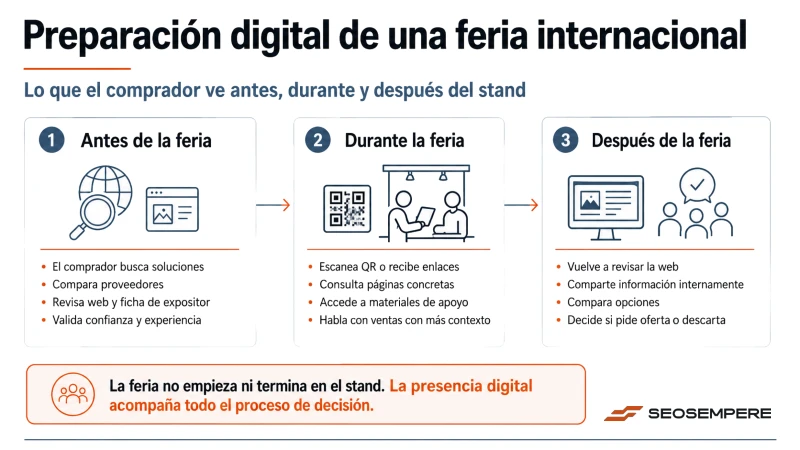
And it continues afterwards, when that contact returns to the office, shares your website internally, compares your solution with other suppliers or decides whether to request more information or let the opportunity pass.
A qualification is useful here.
The trade fair is still an in-person event, and that carries considerable weight in industry. Seeing products, speaking to people, handling samples, resolving technical questions and building trust face to face remain very important. But we cannot assume everything happens there.
In B2B, people do the searching too. A business does not search Google or ChatGPT. A person with a need, pressure and a decision to make does. And that person has often already researched their options before speaking to your sales team.
Preparing for an international trade fair should therefore involve both the stand and the digital presence supporting the event.
We are often told that trade fairs no longer work as they used to. But buying behaviour has changed*, and preparation has changed too. That may be part of the problem.
*In 6sense’s 2024 study, 81% of buyers had chosen a preferred supplier before speaking to a sales representative. Source
What digital preparation for an international trade fair means
Preparing digitally for an international trade fair means more than publishing a news item announcing attendance or posting a photograph of the stand on LinkedIn.
Those activities can form part of the communications plan, which is fine, but they are not enough.
Digital preparation means reviewing and organising the online elements that influence how buyers find, understand and evaluate the business before, during and after the event.
These include:
- The website.
- Product, solution, sector or application pages.
- The language version for the target market.
- Content explaining the technical value.
- A dedicated trade fair page, if creating one makes sense.
- The exhibitor profile on the fair’s website or app, and the LinkedIn profiles of the company and those attending.
- Links and QR codes used during the event.
- Materials the sales team can send before or after a conversation.
- Measurement of visits, enquiries and signs of interest.
The idea is simple.
This is not about attracting traffic for its own sake or building a digital campaign around every trade fair without a reason.
It is about making the business visible, understandable and credible in the market where it wants to sell.
And helping the export team avoid explaining everything from scratch when the website could lay the groundwork, so the business can make better use of its investment.
To review these points individually, request the complete digital preparation checklist for international trade fairs. It is available in English, so you can work through it online with your team or print it and save it as a PDF.
Why many industrial businesses arrive at trade fairs with a digital disadvantage
In my experience, this happens frequently.
The business prepares the operational side well, but arrives with a digital presence that falls short of its sales effort, leaving its preparation incomplete.
This is not always obvious internally. The company knows what it manufactures, that it does it well, and the value of its experience, customers and sectors served. It knows first-hand why its solution makes sense.
But buyers do not start with that knowledge. They see what is available online, where several problems can emerge.
Your business is invisible when buyers search online for a solution
At any point between one trade fair and the next, a potential buyer may have a need your business can meet.
A procurement manager, plant manager, engineer or CEO searches Google or AI platforms for “supplier of”, “manufacturer of” or “specialists in”, or simply searches for a solution to their problem.
If your brand does not appear among the options suggested, it may be left out of the buying process without you knowing.
In a US survey, 57% of B2B decision-makers used search engines during early research, more than any other channel. Source
The website is translated, but not adapted to the market
Translating a website can be a first step, but selling abroad requires more than translation.
German, French, Italian or British buyers may search differently, use different terms, compare different suppliers, need different arguments or have market-specific objections.
Translation changes the words. Localisation adapts the message to how that market understands, searches and decides.
A translation can be accurate and still fail to work.
For example, a business might translate a technical solution’s name literally into English. The text may be well written. But if the market uses another expression, searches by application or does not recognise that category, the page will neither capture the right demand nor help buyers understand its relevance.
You might fool Google for a while, but usually not the buyer.
The website shows products, but does not help buyers decide
Many industrial websites function as catalogues.
- They show products.
- They include technical datasheets.
- They explain features.
- They add a few images.
- They include a contact form.
That may be necessary, but is not always sufficient.
At an international trade fair, buyers are usually comparing more than specifications. They also compare trust, capability, experience, clarity and risk.
They want to know whether the business understands their sector, has worked on similar applications, can provide support and has certifications, case studies, references or guarantees.
They also need to understand why they should consider this supplier rather than another.
A technical datasheet can help, but may not be enough to secure a place on the shortlist.
According to GlobalSpec and TREW Marketing’s 2025 State of Marketing to Engineers report, technical buyers rate an informative, well-maintained website as the strongest indicator of supplier credibility, ahead of prominent trade fair sponsorship. Source
The same study ranks datasheets as the most valued content among technical buyers (79%), ahead of technical publication articles (61%).
The sales team has to explain everything from scratch
When the website does not explain things clearly, your sales team has more work. It must explain who the business is, what it does, which sectors it serves, which problems and needs it addresses and how, justify its value and answer basic questions.
And compensate for the lack of clarity online.
The website will not replace the sales conversation, but it should prepare buyers better for it.
If buyers arrive at a meeting with a better understanding of the solution, the sales team can spend more time discussing their particular situation, application, project and next step.
That is very different from always starting from scratch.
In 89% of manufacturing purchases studied by 6sense in 2024, buyers had fully or mostly defined their requirements before contacting suppliers. Source
Your visible competitors are not always the usual competitors
Another point to review before an international trade fair is who appears when buyers search.
Your competitors on Google or AI platforms are not always the competitors you have in mind.
Results may include a local manufacturer, a distributor, an engineering company that subcontracts manufacturing, a B2B marketplace or a business that communicates better, even if it is no better technically.
A competitor you overlook because it seems small may also appear, having spent years developing digital content in that market.
This matters.
At a trade fair, you may know exactly who you are competing with in the exhibition hall.
But when buyers search online again, they may encounter a different competitive landscape.
And there, the business that explains itself best may have an advantage.
Confidence in the supplier is also built before the fair
Price matters in an industrial purchase, but it is often not the only deciding factor.
An interesting finding is worth considering here. According to dentsu’s Superpowers Index 2025, the leading decision driver in B2B purchases, for the third consecutive year, is: “I feel safe signing a contract with them”.
Put simply, buyers need to feel that choosing you is not a mistake. And they validate that before and after a trade fair too.
They may visit your stand, speak to your team and leave with a good impression. Afterwards, however, they will review the website again, compare suppliers, check what others say about your brand and assess whether the business appears credible, clear and consistent.
Your digital presence matters here because it helps reduce uncertainty, rather than closing the sale on its own.
An industrial SME does not need to look like the biggest business in its sector. But it does need to look like a serious option: one that understands the application, explains its value clearly, shows experience and builds trust before buyers have to ask about everything.
What should a business review before an international trade fair?
Rebuilding the entire website before every trade fair would be unrealistic.
But if a fair is important enough to invest in a stand, travel, a team, samples and sales follow-up, it should also be important enough to review what buyers will see when researching the business.
And more than just what they see.
Also how they find it, whether they understand it quickly, can navigate without friction, whether the target market’s language version works properly and whether the website conveys the reliability the business wants to project.
Digital preparation should start with these areas.
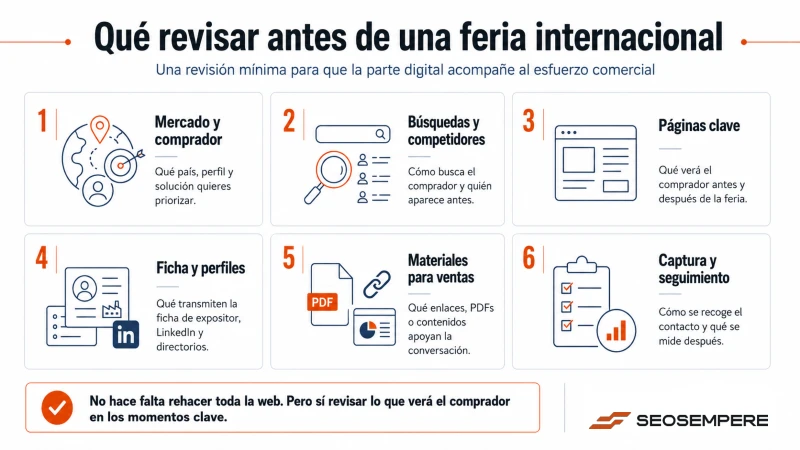
The market, buyer and priority solution
Before discussing pages, content or industrial SEO and GEO, we need to answer a basic question:
Why are we attending this fair?
Saying “to generate contacts” is too generic, because objectives can vary considerably:
- Strengthening a particular market.
- Opening conversations in a country where the business is still relatively unknown.
- Attracting distributors.
- Finding technical partners.
- Introducing a new product line.
- Securing meetings with end customers.
- Strengthening relationships with existing customers.
- Testing interest in a solution within a market.
- Improving perceptions relative to local competitors.
Each objective calls for different digital preparation.
Attending a fair in Germany to recruit distributors is different from attending one in France to sell a technical solution to food manufacturers.
Launching something new is different from strengthening an established product line.
And finding specifiers is different from finding end buyers.
Unless the market, buyer and priority solution are defined, the website and content become generic, which rarely helps industrial businesses sell more effectively.
Searches and visible competitors in the target market
Before an international trade fair, it makes sense to review how the market searches for what the business sells.
Not every fair needs to become a major SEO or GEO project, but some questions should be answered:
- How buyers search for the solution in the target country.
- Which terms they use.
- Whether they search by product, application, problem or sector.
- Which competitors appear.
- Which pages rank.
- Which arguments those competitors use.
- Which information they provide that your business does not.
- Which opportunities exist to improve visibility before and after the fair.
This helps avoid a common situation: entering a market with a translated website without knowing whether buyers search that way.
It also helps identify another, less obvious problem: having published content, even in the right language, that does not reach the country, buyer profile or searches you want.
A business can have a good page in English, French or German without Google necessarily showing it in the right market or for relevant queries.
In this context, rankings or AI citations are not the ultimate purpose of SEO.
The purpose is to understand the market, check whether the business appears when buyers search for a solution it can provide, and identify whether competitors are capturing that demand because they better reflect how the market searches and decides.
Key website pages
Digital preparation should include reviewing the pages buyers are most likely to visit.
Not all pages matter equally. It is usually worth reviewing:
- The homepage.
- Product or solution pages.
- Sector pages.
- Application pages.
- The contact page.
- The target market’s language version.
- Case study, experience or certification pages.
- Pages the sales team will send before or after the fair.
Rather than simply asking whether the website “looks good”, ask whether it helps buyers understand why the business could be a suitable supplier.
- A website can look good while providing little support to sales.
- It can have a modern design without explaining applications clearly.
- It can contain extensive corporate content but little useful buyer information.
- It can provide technical datasheets without reasons to choose the supplier.
- Or offer several languages without being adapted to each market.
The point is this: the website should help buyers move forward.
If it does not, the trade fair loses some of its potential.
A dedicated trade fair page
Creating a dedicated trade fair page can make sense, but not always. It depends on the fair’s size, the market, investment and commercial objective.
If the business attends a small fair with existing customers, a dedicated page may be unnecessary.
For a significant international fair in a priority market, with the aim of attracting new buyers, distributors or partners, it will probably make sense.
However, the page should be more than a news item.
A page saying “We will be at exhibition X from date Y to Z. Visit stand 5B12” adds little. It informs, but does not do much to help buyers decide.
A trade fair page should answer buyers’ questions more effectively:
- Which solutions will be presented?
- Which sectors or applications are they relevant to?
- Which problems do they help solve?
- Which types of business should request a meeting?
- Which team members will be available?
- Which languages will be spoken?
- Where is the stand?
- How can buyers book a meeting?
- Which content can they review before the event?
- Which trust signals are worth highlighting?
Rather than simply saying “come and see us”, give buyers reasons to think: “They could be a good fit.”
Other digital profiles buyers will review
The website is usually the centre of your digital presence, but it is not the only source buyers may consult before an international trade fair.
They may also review:
- The exhibitor profile or trade fair app.
- The company’s LinkedIn profile.
- The profiles of people attending.
- Industry directories.
- Associations.
- B2B marketplaces.
- Channels featuring the company’s technical videos, case studies or demonstrations.
Consistency matters here too.
An exhibitor profile, for example, should go beyond a generic corporate description. Many buyers may see it before deciding which businesses to visit. It should explain what the company does, which needs it addresses, which solutions it presents, which sectors it serves and where buyers should go for more information.
LinkedIn also plays an important role, beyond displaying photographs of the stand.
It can demonstrate activity, judgement, team expertise, specialisation and context. Buyers researching the business or the person they will meet are likely to check consistency between the website, company posts and professional profiles.
There is no need to be on every social network. In industrial B2B, maintaining a few channels well usually makes more sense than opening many without a purpose. But profiles that may appear during buyers’ research should communicate the same things: what the business does, whom it serves, its value and why it could be a credible option in that market.
Content to support the export team
Much of the best industrial content comes from sales.
Recurring questions.
Common objections.
Technical details buyers need to understand.
Sectors where the solution fits best.
Problems the product solves in practice.
Before a fair, turn some of that knowledge into useful content.
You do not need to begin with extensive guides. Focused materials may be enough:
- A clearly explained solution page.
- A page about a particular application.
- A page for a priority sector.
- A simple use case.
- A technical comparison.
- A frequently asked questions page.
- A short PDF to send after a meeting.
- A short video explaining an application or process.
- A page for distributors or partners, if that is the objective.
This is sales support content rather than blog filler, and can be very useful for helping:
- Buyers understand more clearly.
- Sales avoid starting from scratch.
- Conversations from the fair continue.
- Contacts share something more useful internally than a general catalogue.
Website speed and loading experience
It is also worth reviewing how the website loads and behaves.
Before or after a fair, buyers may visit on a mobile phone, from a hotel, on a shared network or from another country. If pages take too long to load, forms fail, important links do not work or the mobile version is awkward, the experience works against you.
A full technical audit is not necessary before every fair. But check the basics: key pages, forms, the mobile version, PDFs, links, the target market’s language version and the trade fair page, if there is one.
In industry, a fast website does not win a deal on its own, but a slow, confusing or awkward website can undermine trust just when the business needs to convey reliability.
What others say about the business when buyers check it
Before an international trade fair, review what appears about the business beyond its own website.
Buyers do not always take your own claims at face value. They often look for external signals to establish whether you are a serious option.
They may check mentions in industry media, associations, industrial directories, distributor websites, B2B marketplaces, exhibitor profiles, LinkedIn, partners, customers, certifications or even old results still appearing on Google.
Several things can happen here.
- There may be very little external evidence.
- Outdated mentions may appear.
- A distributor may explain your product better than your own website.
- The exhibitor profile may have a weak description.
- There may be inconsistencies between the website, LinkedIn and other portals.
- Or competitors may have greater visibility in industry publications, associations or directories.
The aim is to understand what evidence buyers find when trying to reduce risk, and whether it strengthens or weakens their confidence.
At an international trade fair, that external validation can carry considerable weight.
A business that appears in relevant industry sources, maintains a consistent presence and has mentions demonstrating its experience conveys greater confidence.
If there is little trace of it beyond its website, or the information is confusing, outdated or poorly presented, it may look less established than it really is.
What others say about your brand also matters when working towards visibility and possible recommendations in ChatGPT and other LLMs; it does not guarantee a recommendation.
Capturing contacts and continuing the process in the CRM
Review how contacts generated during the fair will be captured and organised.
We know that returning with business cards, loose notes and contacts stored on different phones is not enough.
If the fair matters, there should be a clear, quick and effective way to capture the basics for each opportunity: company, country, role, interest, solution discussed and next step.
A digital system can help: a CRM, event management tool, forms connected to the website or a simpler system if the business does not yet have something more advanced.
The approach matters more than the tool. What counts is preserving the information and connecting each contact with the actual conversation, so the team can identify which solutions generated most interest, which markets responded best and which content can support sales follow-up.
And, of course, following up appropriately.
How to connect the fair with your website without sending everyone to the homepage
Trade fairs typically involve links, QR codes, emails, posts and printed materials.
Often, everything points to the homepage, which is not always the best destination.
If buyers are interested in a particular solution, sending them to the homepage can make them search again for something they have already asked about.
If a potential distributor wants to understand partnership terms, the homepage may not answer their questions.
If an engineering company wants to validate a technical application, the homepage is likely to fall short.
If an overseas buyer wants to know whether the business has experience in their sector, they need a more specific page.
Each link should continue the conversation, rather than restart it.
For example:
- A QR code on the stand can lead to the page for the solution being presented.
- An invitation link can lead to a trade fair page with a meeting booking option.
- An email to distributors can lead to a page designed for partners.
- A LinkedIn post can lead to a page about the specific application being demonstrated.
- A technical PDF can link to a page with more context, case studies or frequently asked questions.
The idea is simple:
Buyers are at different stages and need different information, so they should not all land on the same page.
A well-prepared website helps guide each conversation more effectively.
What buyers should find after the trade fair
Many contacts return to the website after the fair.
Usually to remind themselves what the business does.
Perhaps to share it with someone else.
Often because they are comparing options.
Possibly because they need to justify requesting a quotation internally.
Sometimes simply to check whether the impression from the stand matches the company’s actual presence.
There are two possible scenarios:
In the first, the website confirms the positive impression from the fair.
- Buyers find clear information.
- They understand the solution.
- They see applications.
- They find trust signals.
- They can request information easily.
- They can share a specific page with their team.
In the second, the website cools the opportunity.
- Buyers cannot find what was explained to them.
- The page is too generic.
- The translation sounds unnatural.
- There are no case studies or applications.
- The differentiating value is unclear.
- The next step is not obvious.
This is not always apparent internally, but it can be decisive for buyers.
The first conversation may have gone well. But without a supporting digital presence afterwards, the business may lose ground to suppliers that communicate more clearly.
What to measure to understand whether your digital presence supports the fair
Measuring the return on an industrial trade fair is not always easy. You do not need me to tell you that.
- Sales cycles are long.
- Several people are involved.
- There may be distributors or specifiers.
- Opportunities may mature months later.
- Not everything can be attributed to a click, visit or form submission.
We need to be realistic, but that does not mean nothing can be measured.
Some digital signals help us understand whether activity from the fair is continuing:
- Visits to the trade fair page.
- Visits from priority countries.
- Enquiries received before and after the event.
- Meeting requests.
- Form submissions by solution or market.
- The most visited pages after the fair.
- Materials downloaded.
- International enquiries received.
- The quality of requests, as assessed by sales.
- The content sales uses most.
- Recurring buyer questions.
- Objections raised during the fair.
- Pages that were missing when trying to answer questions more effectively.
The question goes beyond “how many leads or enquiries did we get?” In industry, as you know, 15 good contacts can be worth more than 300 business cards without context.
A more useful question is:
Which real opportunities did the fair generate, and what could the business have prepared better to help buyers move forward with greater confidence?
Example: an industrial business attending a trade fair in Germany
Let us make this more concrete with an example.
Imagine a business manufacturing technical equipment for industrial processes and attending a trade fair in Germany.
It wants to strengthen that market because it already has some sales, but growth has fallen short of expectations.
It has a German website, but it is fairly basic. Let us imagine that:
- The main product page is translated but uses overly literal terminology.
- There are no application pages.
- There are no case studies.
- Its differences from local suppliers are not explained clearly.
- The contact page is generic.
- Visibility has plenty of room for improvement: searches for the solution in German show competitors who may be no better, but explain themselves more clearly.
The business can attend with a good stand and a strong sales team.
But it will arrive at a digital disadvantage. Something we see quite often.
Before the fair, it could review:
- How German buyers search for that solution.
- Which competitors appear for those searches.
- Which terms the market uses and which are too internal to the business.
- Which page should explain the main application better.
- Which trust signals are missing.
- Which content sales could send after a conversation.
- Which page should receive traffic from the fair.
With those answers, it may not need to rebuild the entire website.
It may be enough to create a well-developed application page.
Adapt the main product page.
Prepare a simple trade fair page.
Add case studies or sector examples.
Improve the value arguments.
Define better destinations for the links used before and after the event.
Does that guarantee sales? Honestly, no. Anyone promising that would be oversimplifying.
But it does reduce friction.
- Buyers understand more clearly.
- The sales team has better materials.
- The business looks better prepared.
- Conversations continue with greater clarity.
- And the fair produces more learning than a simple contact list.
Digital preparation checklist for international trade fairs
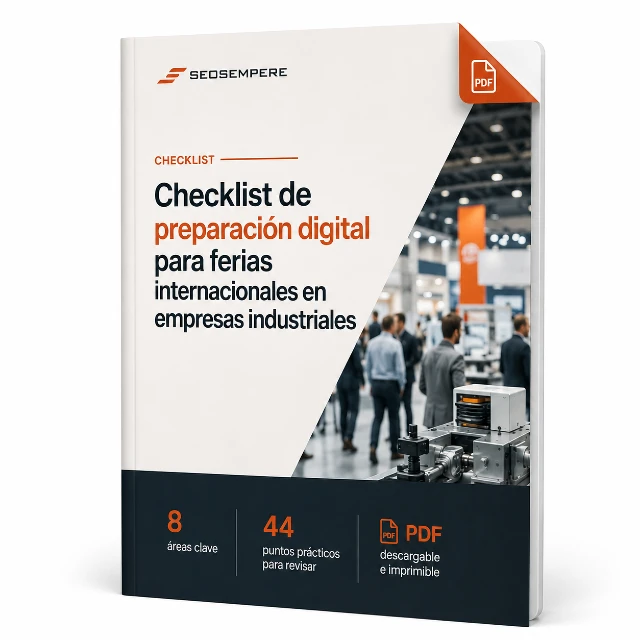
Before investing in an international trade fair, review something many businesses overlook:
Do your digital assets support or hinder that sales effort?
Use the English checklist to review eight areas and 44 practical checks covering your target market, buyer research, priority website pages, trade fair links, digital profiles, sales content, contact capture and measurement. Work through it online with your team, or print it and save it as a PDF.
Please read our privacy policy before submitting this form.
You do not need to do everything, but you do need to choose well
It depends on the sector, market and size of the fair. Not every business needs a large digital campaign before every event, a dedicated landing page for each fair or new content.
And certainly not every business has the team or resources to prepare a complex system.
But that does not mean there is nothing to do. With limited resources, it usually makes more sense to prioritise a few activities with impact.
For example:
- Review the page for the solution being presented.
- Adapt the message to the priority market.
- Create a simple trade fair page.
- Prepare useful follow-up content.
- Define which links or QR codes will be used.
- Measure subsequent enquiries and visits.
Often, the website does not need rebuilding from scratch. It needs the information buyers will see at key moments to be organised.
Those moments are usually before the fair, during the conversation and after first contact.
This goes beyond bringing more people to the stand
Let us be clear. This is not a magic formula for filling a stand, nor is that its main objective.
The approach described here serves a broader purpose. It involves:
- Understanding how the market searches.
- Identifying which competitors appear.
- Checking whether the business uses the right language.
- Preparing pages that better answer buyers’ needs.
- Capturing demand before and after the fair.
- Working to reinforce the message beyond our own channels.
- Helping the website support sales, rather than function only as a catalogue.
It is about useful visibility and sales opportunities, beyond website visits alone.
Because part of your market is already searching. The question is whether they find you, a competitor, a distributor or nobody relevant.
Conclusion: if the fair matters, so does your digital presence
However often we hear that trade fairs are not what they used to be, or are “only worthwhile for speaking to existing customers”, an international fair can still be one of an industrial business’s most important sales activities.
But it should not be treated as an isolated event.
Before the fair, buyers may be searching.
During the fair, they need to understand quickly whether you fit.
After the fair, they may return to your website to compare, validate and decide whether to proceed.
Without a supporting digital presence, the export team carries a heavier workload, as we have seen:
- It has to explain everything from scratch.
- It has to answer questions the website could have prepared buyers for.
- It has to compensate for a lack of clarity online.
- It has to defend value that may not be clearly explained anywhere.
The website does not replace sales, but it should support sales. At an international trade fair, that means approaching the market with greater clarity, more context and more trust already established.
If a market is important enough to invest in a trade fair, it should also be important enough to review what buyers see when searching for a solution like yours.
Next step
If this article has highlighted that your website is not supporting sales before, during or after an international trade fair, it may be worth reviewing more than attendance at the event.
At SEOSEMPERE, we work on industrial SEO to help the right buyers find, understand and consider technical B2B businesses before the first sales conversation.
See how we approach SEO for industrial businesses