

B2B SEO helps businesses that sell to other businesses gain visibility when potential customers search for products, solutions or suppliers. An effective strategy should start with commercial objectives, understand how buyers research their options, and develop website architecture, content and authority to help them find and assess the business, both on Google and through artificial intelligence tools.
Imagine a manufacturer that has been selling its products in Spain and several international markets for years. It has good customers, experience and a sales team that knows exactly what it sells.
Yet when someone searches Google for a solution like theirs, the company barely appears. And if that person does reach its website, they find a catalogue of technical product references, but little information about applications, benefits or completed projects.
That potential buyer may end up looking elsewhere.
They might also discover the business at a trade fair, on LinkedIn or through a recommendation. Before getting in touch, they do their own research. They visit the website, look for references and try to establish whether this supplier can meet their needs.
And there are increasingly more ways to carry out that research, including artificial intelligence tools such as ChatGPT.
In this context, B2B SEO helps improve visibility among buyers searching for products, solutions or suppliers, and gives them enough information to decide whether it is worth getting in touch.
The strategy needs to suit the business. Selling management software to small businesses is quite different from manufacturing industrial equipment to technical specifications.
Let us look at how to approach it, what to prioritise, and the roles Google, GEO and digital PR play today.
Contents
- What is B2B SEO?
- Differences between B2B and B2C SEO
- How B2B buyers search for and choose suppliers
- The same product can answer very different searches
- How to develop a B2B SEO strategy step by step
- 1. Start with the business objectives
- 2. Understand buyers before researching keywords
- 3. Research B2B keywords, even when tools show no search volume
- How can you research searches that tools do not detect?
- Real example: when Search Console reveals what we had not anticipated
- 4. Design a website architecture around products, solutions and buyers
- Real example: how a new SEO architecture supported sales enquiries for a B2B SaaS business
- 5. Create content that helps buyers evaluate the business
- What should a good B2B commercial page include?
- 6. Resolve technical issues that affect visibility
- 7. Adapt SEO to each international market
- Link building and digital PR in B2B: building authority for Google and AI tools
- Why prioritise specialist publications and sources relevant to your sector?
- From link building to digital PR: what changes with GEO?
- Digital PR activities that make sense for a B2B business
- B2B SEO and GEO: improving visibility on Google, ChatGPT and other AI tools
- What is GEO, and how does it differ from SEO?
- How a B2B query changes when the buyer uses AI
- What I would work on in GEO for a B2B business
- Clear information about the business and its capabilities
- Original content and first-hand knowledge
- References and presence in external sources
- Accessibility and crawling
- How to research what buyers might ask AI
- How to measure B2B SEO and visibility in AI
- Search Console and Analytics: useful, but insufficient on their own
- The CRM and sales team also provide SEO insights
- How to measure visibility in ChatGPT and other AI tools
- New AI visibility reports
- Common B2B SEO mistakes
- Choosing keywords purely by volume
- Organising the website exclusively around the catalogue
- Publishing articles before addressing commercial pages
- Entering markets without adapting content
- Pursuing backlinks without considering sector relevance
- Treating GEO as a solution separate from the rest of the website
- Measuring only visits and rankings
- When B2B SEO is worth investing in, and what to do first
- How should you set priorities in B2B SEO?
- What to prioritise depending on the business’s situation
- What should start happening in the first few weeks?
- How long does B2B SEO take to deliver results?
- B2B SEO should also help when buyers already know your business
What is B2B SEO?
B2B (business-to-business) SEO is the set of strategies and activities designed to improve a company’s organic visibility among other businesses searching for its products, services or solutions.
It includes keyword research, website structure, technical optimisation, content and website authority, among other areas.
The fundamentals are the same as conventional SEO. What changes is the business it serves, how buyers search and what they need to know before making a decision.
For example, a heat exchanger manufacturer may want to appear for searches about its products, but also reach businesses researching energy recovery solutions for particular industrial processes.
In some cases, the buyer knows the exact name of the equipment. In others, they start with a need and do not yet know which technology to use.
A B2B SEO strategy should account for both situations.
Differences between B2B and B2C SEO
Although they share techniques and tools, there are some common differences.
| Aspect | B2B SEO | B2C SEO |
|---|---|---|
| Buyer | A business; several roles may be involved | Usually an end consumer |
| Searches | Often specialised, technical and lower-volume | Demand is broader in many sectors |
| Decision | May require technical, financial and commercial approval | Often more straightforward |
| Content | Solutions, applications, specifications, comparisons and case studies | Features, benefits, prices, reviews and availability |
| Conversion | Enquiries, requests for quotation, meetings and sales opportunities | Often sales, bookings or enquiries |
| Measurement | The quality of opportunities and their contribution to the business matter | It is usually easier to connect visits with transactions |
These are not absolute rules. Some B2B purchases are simple, while some B2C purchases involve months of research.
What matters is understanding how people buy what each business sells.
How B2B buyers search for and choose suppliers
A B2B purchase can involve several people with different interests.
A technical manager may research performance, materials or compatibility. Procurement may assess suppliers, risks and terms. Senior management may need to justify an investment.
And the person who starts looking for information is not necessarily the person who ultimately approves the purchase.
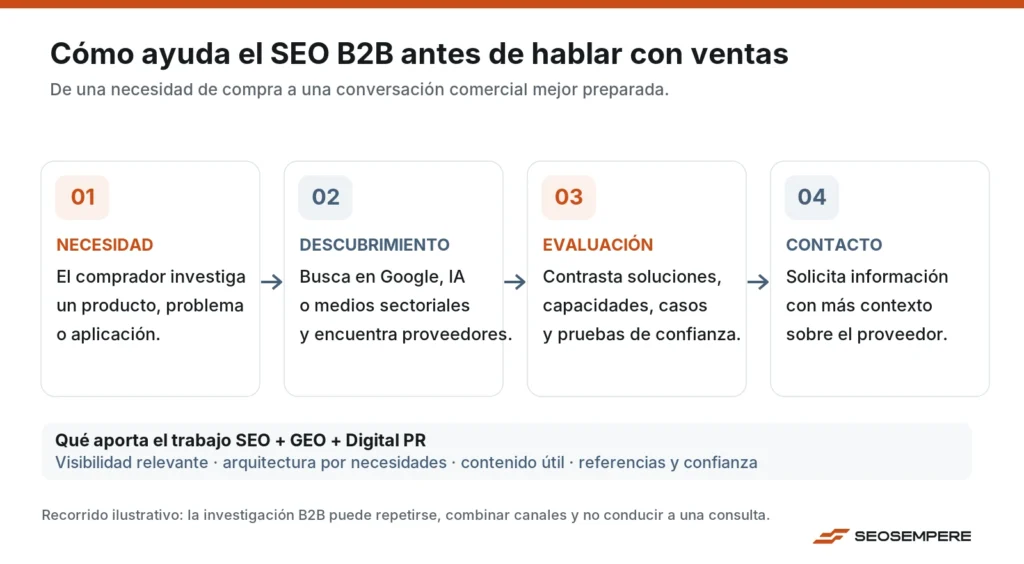
The journey is also rarely linear. A buyer may discover a supplier at a trade fair, research it on Google, consult a colleague and return to the website weeks later.
That is why reducing B2B SEO to attracting visits and generating form submissions can overlook some of its value.
The same product can answer very different searches
Consider a business that manufactures heat recovery equipment for industrial processes.
A potential customer might search directly for equipment, research an application or compare technologies.
| What they need to know | Illustrative search | What they should find |
|---|---|---|
| Find a product | Industrial heat recovery equipment manufacturers | Manufacturers, solutions and features |
| Solve a problem | Waste heat recovery in industrial processes | Applications and technical options |
| Evaluate alternatives | Heat recovery systems for hot gases | Selection criteria and limitations |
| Validate experience | Heat recovery projects in the chemical industry | Case studies, installations and demonstrable experience |
| Consult a supplier | Bespoke thermal recovery equipment design | Technical capabilities and sales contact details |
These queries illustrate different search intentions; they are not presented as keywords with verified demand.
Each need might require a different page, although not always.
And this is where one of the mistakes I most often see on B2B websites comes in: organising everything from the manufacturer’s perspective, without giving enough thought to how buyers search.
The product matters, of course. But so can applications, sectors, use cases and the problems it solves.
A business can be well known within its specialism yet practically invisible to someone searching for the solution in different words.
How to develop a B2B SEO strategy step by step
1. Start with the business objectives
Before opening an SEO tool, we need to understand what the business wants to achieve.
It may want to build visibility for a product line, strengthen its position in a market, launch a solution or attract opportunities from particular sectors.
It is also useful to understand what the sales team can handle and where the business has competitive advantages.
A business with twenty product families might prefer to focus on three because they offer better margins, are growing or have greater production capacity available.
If we start with the highest-volume keywords without that information, we may spend resources on searches that contribute little to the business.
For me, that is one of the first decisions in a B2B SEO strategy: choosing where to focus our efforts.
That decision should involve marketing, senior management and, where appropriate, the sales team.
2. Understand buyers before researching keywords
In many B2B projects, some of the most useful information for SEO is already inside the business.
Salespeople know what customers ask, which objections arise and how they describe their needs.
Marketing can contribute information about campaigns, sectors, markets and content.
The technical team understands applications, differences between products and the conditions that make one solution more suitable than another.
With that information, we can begin to investigate:
- Which problems each type of buyer is trying to solve.
- Which products or technologies they know.
- Which alternatives they might consider.
- Which criteria they use to choose.
- Which questions they ask before getting in touch.
- Which arguments and evidence they need to trust a supplier.
Research should go beyond collecting technical terms. We also need to understand the language used in the market.
3. Research B2B keywords, even when tools show no search volume
This deserves particular attention.
Many B2B searches are highly specific. They combine products, materials, applications, sectors, technologies or technical requirements.
And tools such as Ahrefs or Semrush do not always include these queries in their databases.
In certain niches, you may find searches listed with no volume, or not listed at all.
That does not necessarily mean nobody makes those searches.
How can you research searches that tools do not detect?
In B2B niches where SEO tools show no search volume, research can start with customer questions, sales insight, technical terminology and competitor analysis. These sources help us develop hypotheses that can then be tested and refined using real data, particularly from Google Search Console.
In practice, we can draw on:
- Knowledge of the business and its buyers.
- The questions salespeople receive.
- Technical terminology and catalogues.
- Competitor and supplier websites.
- Search engines and their results.
- Research supported by artificial intelligence.
- Search Console data, if the website has an established search presence.
AI can help explore how a buyer might phrase their queries, identify related needs and broaden the search vocabulary.
But suggestions from AI remain hypotheses until we find evidence to support them.
Real example: when Search Console reveals what we had not anticipated
The starting point
On a project for a highly specialised B2B consultancy, we faced a challenge: it operated in a niche, and the usual tools offered little information about how different types of customer might search for its services.
How we researched it
The initial research drew on knowledge of the business, the available information about its buyers and various search hypotheses.
On that basis, we organised the content and started working on its visibility.
What we discovered
Over time, Search Console began to show real queries.
Some confirmed that the initial direction made sense, but we also found ways of searching that we had not anticipated.
That information allowed us to improve existing pages and identify a specific need that justified developing new content.
The lesson
In certain B2B niches, a significant part of keyword research emerges after work on the website has begun.
First, we research and develop hypotheses. Then, as data becomes available, we can refine them.
Naturally, Search Console has limitations. It does not show every search in the market, only information about searches for which our website has had visibility, subject to the restrictions of its reports.
So we should not dismiss an opportunity simply because it does not yet appear in our data.
4. Design a website architecture around products, solutions and buyers
Once we understand what the market is searching for, we need to decide how to organise the information.
A B2B business may need pages for product families, solutions, applications, sectors, services or customer profiles.
What matters is giving each page a clear purpose.
Consider a manufacturer that sells the same equipment for different industrial applications.
These applications may share technical features, but selection criteria can vary considerably depending on the process or industry.
In that case, a generic product page may not meet all those needs well enough.
Equally, creating twenty almost identical pages by changing only the sector name would make little sense.
The decision depends on demand, meaningful differences between applications and the useful information we can provide.
Real example: how a new SEO architecture supported sales enquiries for a B2B SaaS business
The starting point
We worked with a B2B SaaS business whose website concentrated almost its entire offering on the homepage.
The company served different ideal customer profiles (ICPs) and operated in several markets, but its website did not adequately reflect each one’s specific needs.
What we did
We designed and implemented a content architecture around those profiles and markets.
We adapted the content to address each type of buyer’s problems and needs, explain the solutions and show why the business could be a suitable choice.
We also included case studies and customer reviews to demonstrate its experience and build trust.
And because it operated in several markets, we went beyond translating the messages: we localised and adapted them.
The results we observed
After the new architecture went live, the website went from generating no sales opportunities on its own to attracting qualified enquiries in several markets.
But one change was particularly interesting.
The buyers who got in touch already understood the company’s value and considered it a strong option. The sales team did not need to explain the entire value proposition from scratch.
The lesson
A well-planned B2B SEO architecture can help capture demand and enable buyers to progress with their research before speaking to sales.
This result relates to one specific experience. It does not demonstrate that a new architecture automatically produces the same effect for other businesses, or that SEO was the only factor contributing to the opportunities generated.
What matters is understanding the role a website can play: helping buyers understand the solution, assess the supplier and arrive better prepared for a sales conversation.
5. Create content that helps buyers evaluate the business
Not every B2B search needs a blog article.
In fact, on many projects I consider improving product, solution or service pages a higher priority than constantly publishing new articles.
A buyer who knows the technology well and is looking for a manufacturer may need specifications, applications, certifications, production capabilities and references.
If they land on a page full of introductory explanations, they are unlikely to find what they need.
Another buyer, however, may be comparing alternatives and need a technical guide to help them choose.
Both types of content are useful, but they serve different stages.
What should a good B2B commercial page include?
A B2B commercial page should enable a potential buyer to understand the company’s solution, the applications it can serve and the evidence that helps them assess whether the supplier fits their needs. The information required depends on the product, sector and the buyer’s technical knowledge.
Elements worth considering include:
- The solution the business offers and the needs it addresses.
- Applications and sectors in which it is used.
- Relevant technical specifications.
- Benefits and limitations, where appropriate.
- Criteria for choosing between alternatives.
- The supplier’s capabilities and experience.
- Case studies, references and customer reviews.
- Certifications or other verifiable evidence.
- How to request information, advice or a quotation.
Some businesses explain their products’ features in exhaustive detail, yet devote very little space to demonstrating why buyers should choose them.
And that can affect conversion too.
The website should help answer the questions the sales team regularly encounters in conversations.
6. Resolve technical issues that affect visibility
A good content strategy needs a website that search engines can crawl and interpret correctly.
Areas to review include:
- Whether important pages can be indexed.
- Internal linking architecture.
- Canonical tags and potential duplication.
- Titles, headings and relevant elements on each page.
- Performance and the browsing experience.
- Crawl errors and redirects.
- Structured data, where relevant.
- Language and market configuration.
Manufacturers’ websites also commonly contain important information in PDFs, downloadable catalogues or pages with very little accessible content.
PDFs can be useful for buyers, but it is worth considering which information should also be available on HTML pages that make solutions easier to discover, understand and connect.
Not every project needs an extensive technical audit.
Some websites have major problems that need resolving before expanding their content. Others have a reasonable technical foundation, with the main opportunities lying in architecture or how the offering is presented.
7. Adapt SEO to each international market
A business operating in several countries needs to investigate how buyers search in those markets.
The same product may have different names, serve different applications or compete with alternatives that are not relevant in Spain.
Required certifications, sales arguments and buyer expectations may also vary.
That is why an accurate translation does not guarantee that the content meets local demand effectively.
Localisation can affect keywords, architecture, messages, evidence of experience and calls to action.
And we need to prioritise.
If a business wants to target six countries but has limited resources, it may be better to focus initially on those where it has greater sales capacity or a better-supported opportunity.
On other projects, working on several markets at once will make sense.
The decision should reflect the business and its ability to implement the work.
To explore this further, this other article explains how to approach an international SEO strategy (in Spanish).
Link building and digital PR in B2B: building authority for Google and AI tools
SEO also involves work beyond our own website.
Links from other pages still matter to search engines, both for discovering content and within the systems that assess its relevance.
That is why link building remains part of many B2B SEO strategies.
However, if we also want to improve our presence in artificial intelligence tools, I believe we should increasingly approach this work through digital PR.
Why prioritise specialist publications and sources relevant to your sector?
Imagine a business that manufactures packaging machinery.
It could obtain links from general-interest blogs about business or technology. But it would probably make more sense to seek coverage in specialist packaging publications, industrial associations, technical media or content aimed at production managers.
The relevance of these sources goes beyond their SEO metrics.
They are places where its buyers, distributors, specifiers and other industry professionals may be found.
A good publication can also accurately connect the business with its technologies, applications and specialisms.
That helps build a coherent digital presence beyond its own website.
From link building to digital PR: what changes with GEO?
In traditional SEO, we have paid considerable attention to obtaining links from relevant domains.
With the arrival of AI tools, how our business is described in external sources also matters.
A specialist publication might publish a technical article mentioning our company, explaining a solution and quoting one of our experts.
That coverage may generate a link, but it also provides contextual information about what we do.
And AI tools that consult external sources to construct their answers could use that information.
Some research points to a strong relationship between brand mentions and visibility in AI.
For example, Ahrefs analysed 75,000 brands in a study published in December 2025 and found stronger correlations between brand mentions and AI visibility than between backlink counts and that visibility.
It is an interesting finding, but needs careful interpretation. A correlation does not prove that securing a mention causes ChatGPT to recommend our company. Nor are the brands studied necessarily representative of every B2B niche.
Even so, it supports a direction I consider sensible: developing brand presence and reputation in relevant sources, without limiting the strategy to accumulating backlinks.
Digital PR activities that make sense for a B2B business
Possible opportunities include:
- Publishing technical studies using proprietary data.
- Contributing to specialist magazines.
- Participating in articles about industry technologies or applications.
- Sharing completed client projects, with permission.
- Contributing engineers’ and experts’ knowledge to external publications.
- Working with professional associations and industry organisations.
- Taking part in interviews, technical events or partner publications.
Not every business has the resources to pursue all these activities.
I would choose those that enable the business to contribute relevant information and make sense for its buyers and sector.
My approach is to prioritise sector relevance, editorial quality and the potential performance of the content over pursuing links purely for their authority metrics.
And to avoid practices designed to manipulate rankings through artificial links or links bought to pass ranking credit. As well as being difficult to sustain, these can conflict with Google’s spam policies.
SEO specialists know there is a grey area between what Google calls spam and what actually causes harm or fails to work. That is often where opportunities offering a good balance of quality, effectiveness and cost can be found, in exchange for accepting certain risks.
B2B SEO and GEO: improving visibility on Google, ChatGPT and other AI tools
Until relatively recently, researching a company’s online visibility primarily meant examining how it appeared in search engines such as Google.
Now we also need to consider tools that can generate answers, compare alternatives and help research solutions.
This is where GEO comes in.
What is GEO, and how does it differ from SEO?
GEO stands for Generative Engine Optimisation and describes work aimed at improving the presence of a brand, business or content in AI-powered search and answer experiences.
Traditional SEO aims to improve pages’ visibility in search results.
With GEO, we also want AI systems to find relevant information about our business, understand its capabilities and consider it when answering related questions.
The two approaches share considerable work: technical accessibility, useful content, well-organised information, authority and external references.
But there are also differences in how results are presented and how buyers can interact with them.
In any case, we need to avoid a misconception: Google and ChatGPT do not work in exactly the same way, and we cannot assume that every AI tool uses the same sources or mechanisms.
How a B2B query changes when the buyer uses AI
Imagine a production manager asking ChatGPT:
“I need to reduce energy consumption at an industrial facility that produces hot gases. Which heat recovery technologies should I consider, what are their limitations, and what criteria would you use to search for European manufacturers?”
Answering this requires considerably more than finding a page that matches a keyword.
It may involve researching technologies, operating conditions, alternatives, limitations and criteria for assessing suppliers.
In Google’s AI experiences, for example, a technique called query fan-out is documented: the system can run several related searches across different subtopics to build a more comprehensive answer.
A complex question may need information about:
- Heat recovery technologies.
- Applications across industrial processes.
- Conditions that affect equipment selection.
- Technical alternatives and their limitations.
- Manufacturers and their capabilities.
These are illustrative subtopics, not a reproduction of internal queries executed by Google or ChatGPT.
This has an implication for B2B SEO.
If our website only has a generic product page, it may not be sufficient to address all those needs.
An architecture that explains products, applications, technologies, selection criteria and experience, however, can offer relevant information for different parts of the research.
There is no point creating pages for every possible AI question. We need to identify the information buyers actually need and organise it usefully.
What I would work on in GEO for a B2B business
Clear information about the business and its capabilities
The website should make it possible to understand what the business does, which solutions it offers, which sectors it serves and which markets it can operate in.
Where relevant, it should show technical capabilities, certifications, experience and verifiable case studies.
We should not assume an AI system will correctly infer all that information from a catalogue of product references or vague sales messages.
Original content and first-hand knowledge
Real experience has value.
A manufacturer can publish information that is hard to find in a generic guide: technical selection criteria, common installation problems, a solution’s limitations or lessons from completed projects.
That content helps buyers and can provide distinctive information for systems that consult external sources.
Indeed, Google recommends original, experience-based content for its generative search experiences.
References and presence in external sources
The information we publish on our website should be consistent with what appears in specialist media, associations, professional directories and other sources.
Digital PR is relevant here again.
The better our capabilities are documented and communicated, the more opportunities buyers and systems consulting external information have to find them.
That does not imply an automatic relationship between mentions and AI recommendations.
Accessibility and crawling
There is also a technical element.
For a website to be eligible to appear in ChatGPT Search results, it is worth checking that it allows OAI-SearchBot to crawl it and that its server or website protection tools are not blocking access.
OpenAI explains these conditions in its documentation on appearing in ChatGPT search.
For Google, official recommendations for its AI features continue to rest on SEO fundamentals: useful, indexable and technically accessible content.
Structured data can help describe information in an organised way where appropriate, but there is no special tag that guarantees a citation in ChatGPT.
How to research what buyers might ask AI
Here we face a challenge similar to some low-volume B2B keywords, but with greater measurement limitations.
We do not have a general equivalent of Search Console showing every question buyers ask ChatGPT about our sector.
So research needs to draw on knowledge of the business, buyers’ needs and the queries they might use.
AI can also help us explore questions and scenarios.
We can then run checks in ChatGPT and other tools, observing which brands appear, which sources are cited and whether answers accurately describe our solutions.
What matters is treating these checks as samples from a variable system.
An isolated answer does not demonstrate that our business is consistently visible across every user, market or way of phrasing a question.
How to measure B2B SEO and visibility in AI
Measurement presents some challenges in B2B.
Buying cycles can be long. Enquiries arrive through different channels, and buyers sometimes visit the website several times before emailing or calling.
Nor is every contribution made by a website recorded as a direct conversion in Analytics.
To evaluate the work properly, it is useful to distinguish three levels.
| Level | What we can measure | What it helps us understand |
|---|---|---|
| Implementation | Published improvements, pages created, errors resolved and content updated | Whether the planned work is being delivered |
| Visibility and consideration | Relevant queries, clicks, visible pages, markets, enquiries and mentions in AI | Whether we are increasing opportunities to be found and evaluated |
| Commercial results | Qualified enquiries, sales-accepted opportunities and attributable business where traceability exists | The commercial contribution we can observe |
Search Console and Analytics: useful, but insufficient on their own
Google Search Console lets us analyse queries, pages, clicks and impressions.
In B2B, I am particularly interested in searches that may come from relevant buyers, how important pages are performing and which new terms start to appear.
Analytics can help us understand visitor behaviour and record certain enquiries or actions.
But measurement needs to be configured correctly, and we need to understand its limitations.
An increase in traffic does not, on its own, demonstrate that the work is generating better sales opportunities.
The CRM and sales team also provide SEO insights
Some information is worth checking directly with sales.
For example:
- What types of enquiry are coming in?
- Are they from businesses that match our ideal customer profile?
- Which solution do they need?
- How did they hear about the business?
- What did they know before getting in touch?
- Which questions need answering during the sales process?
Sometimes someone arrives through a recommendation or trade fair but visits the website before writing.
Attributing that entire opportunity to SEO would be wrong. So would concluding that the website played no part because the final enquiry came by email.
Several channels are involved in many B2B buying processes.
Measurement should help us understand that contribution without inventing attribution.
How to measure visibility in ChatGPT and other AI tools
We can build a set of questions relevant to our buyers and periodically check the answers different platforms generate.
It is useful to analyse brand mentions, citations and sources, the context in which we appear and competitors’ presence.
We can also review referral traffic from AI tools where it can be identified.
But none of these metrics provides a complete picture on its own.
New AI visibility reports
Alongside regular checks, tools now provide specific data about websites’ presence in AI-generated answers.
Google Search Console introduced specific performance reports for generative AI features in 2026.
These reports make it possible to analyse page impressions in experiences such as AI Overviews and AI Mode, including trends and breakdowns by page, country or device.
The data forms part of Search Console’s measurement ecosystem, with dedicated views for these experiences.
You can read Google’s official announcement of its generative AI reports.
Bing Webmaster Tools also introduced AI Performance, a feature for examining how website content is cited in certain Microsoft AI experiences.
Its metrics include:
- Number of citations as a source.
- Website pages that have been cited.
- Citation trends.
- Queries used to retrieve information (grounding queries).
The latter represent a sample of retrieval activity, not a complete record of questions asked by every user.
Microsoft describes these metrics in its official AI Performance announcement.
These are useful developments because they provide information we did not previously have.
However, we need to understand what each platform measures. An impression in a Google AI feature, a citation recorded by Bing and a brand mention in ChatGPT are not equivalent metrics.
Nor should we interpret these reports as a complete measure of our share of AI visibility.
Results can change with language, context, tool, wording or the timing of a query.
And, as with traditional SEO, greater visibility does not guarantee a sale.
Common B2B SEO mistakes
Choosing keywords purely by volume
A low-volume search can be relevant to a business selling highly specialised solutions.
And a popular keyword can attract an audience with no prospect of becoming customers.
Volume is useful data, but needs commercial context.
Organising the website exclusively around the catalogue
Product pages are necessary, but may leave searches about applications, problems, sectors or solutions unanswered.
Review what buyers need to know and whether the website explains it adequately.
Publishing articles before addressing commercial pages
A blog can bring visibility, but may not be the priority if the main business pages barely explain the offering.
Before planning monthly articles, I would review which information is missing for researching and evaluating products or services.
Entering markets without adapting content
Translating a website into several languages can broaden its reach, but does not guarantee it uses the language of buyers in each market.
Research and localisation are needed where meaningful differences exist.
Pursuing backlinks without considering sector relevance
Accumulating links from any website can be less useful than securing good editorial references in publications and organisations relevant to the business.
External authority work should also consider who might discover the business through those sources.
Treating GEO as a solution separate from the rest of the website
It is difficult to work effectively on AI visibility if the business does not clearly explain what it sells, which needs it addresses and why it should be considered.
GEO adds new research and measurement questions, but much of the work rests on familiar fundamentals.
Measuring only visits and rankings
A report can show SEO improvements without answering the question that really matters to the business: whether we are reaching the right buyers and helping them evaluate our company.
Wherever possible, data should be connected to commercial priorities.
When B2B SEO is worth investing in, and what to do first
Not every business needs to start with the same activities.
A business with a technically poor website may need to resolve crawling and indexing problems.
Another may have a website that works correctly but an architecture that overlooks its main solutions.
Another may already have sufficient visibility for some products and need to focus on international markets, external authority or new applications.
How should you set priorities in B2B SEO?
To prioritise a B2B SEO strategy, first identify relevant commercial opportunities, analyse how buyers search and establish what prevents the business from meeting that demand. Depending on the starting point, the priority may be improving commercial pages, resolving technical issues, developing new content or strengthening authority.
Before starting, I would review four questions:
1. Where is the commercial opportunity? Which products, services, buyers or markets make sense for the business?
2. What demand can we identify? How do those buyers search, which needs do they research and what presence does the business currently have?
3. What prevents us from meeting it? Technical problems, missing pages, insufficient content, lack of evidence to build trust or limited external authority.
4. What can we actually implement? Resources, responsibilities, coordination with web development, access to technical information and capacity to maintain content.
This enables us to decide where to focus our efforts.
What to prioritise depending on the business’s situation
| Business situation | First SEO priority |
|---|---|
| Product catalogue with little information | Improve commercial pages, applications and solutions. |
| Technical niche with keywords showing no volume | Qualitative research and ongoing validation with Search Console. |
| Different ICPs and markets | Architecture and content adapted to each need. |
| Organic traffic but few suitable enquiries | Review search intent, conversion pages and sales data. |
| Little presence in industry sources | Digital PR and relevant external references. |
| Crawling or indexing problems | Resolve technical issues before expanding content. |
This table is an initial guide. An audit and knowledge of the business may change the order of priorities.
For example, a little-known business may need to strengthen its external authority, but serious indexing problems on its website may need to be resolved first.
What should start happening in the first few weeks?
Completing an audit and delivering a document of recommendations is not enough.
A strategy needs to produce visible changes.
Depending on the starting point, the first few weeks should be used to agree priorities, establish available measurement, resolve important issues and start improving or publishing pages that address specific needs.
We also need to identify which work depends on the SEO team and which requires support from marketing, salespeople, technical specialists or developers.
This matters because a good recommendation that is never implemented is unlikely to improve results.
How long does B2B SEO take to deliver results?
There is no timeframe that applies to every business.
It depends on the website’s starting point, competition, markets, work required and ability to implement changes.
It is also useful to distinguish three stages.
First, work is implemented: problems are fixed, content published and pages improved.
Then we may begin to observe signals of visibility and user behaviour.
Finally, if demand exists and the business’s offering fits, sales opportunities may emerge.
The three stages do not necessarily progress at the same pace.
And if a business needs immediate opportunities, other channels such as paid campaigns or sales prospecting should be considered, rather than expecting SEO to deliver results we cannot guarantee within a short timeframe.
B2B SEO should also help when buyers already know your business
So far, we have focused mainly on capturing existing demand, but there is another scenario I consider particularly important.
A business can generate interest through trade fairs, LinkedIn, sales visits, distributors or recommendations.
The potential customer then does their research.
They search for the brand, review its website and products, and check whether there is enough information to trust it.
At that point, a well-organised website with clear technical information, applications, experience and social proof can support the sales team.
Buyers arrive better informed, understand what the business can offer and have more reasons to include it among potential suppliers.
That was one of the most interesting lessons from the B2B SaaS example described earlier.
And it is one reason I believe a B2B SEO strategy should take a broad commercial view, even when some of its contributions are difficult to attribute directly.
The aim is to help the right buyers find the business, understand its value and have reasons to consider it.
Google, ChatGPT and other tools can play a part in that process. So can owned content, external references and other sales and marketing activities.
What matters is that the strategy responds to the business’s real needs and can be implemented.
At SEOSEMPERE, we approach SEO for manufacturers and industrial businesses from that perspective: products, applications, buyers, markets and visibility in search engines and AI tools.
To explore the opportunities for your business, find out how we approach industrial B2B SEO.